The deadline to submit a proposal was May 14, 2026, at 11:59 PM (PT).
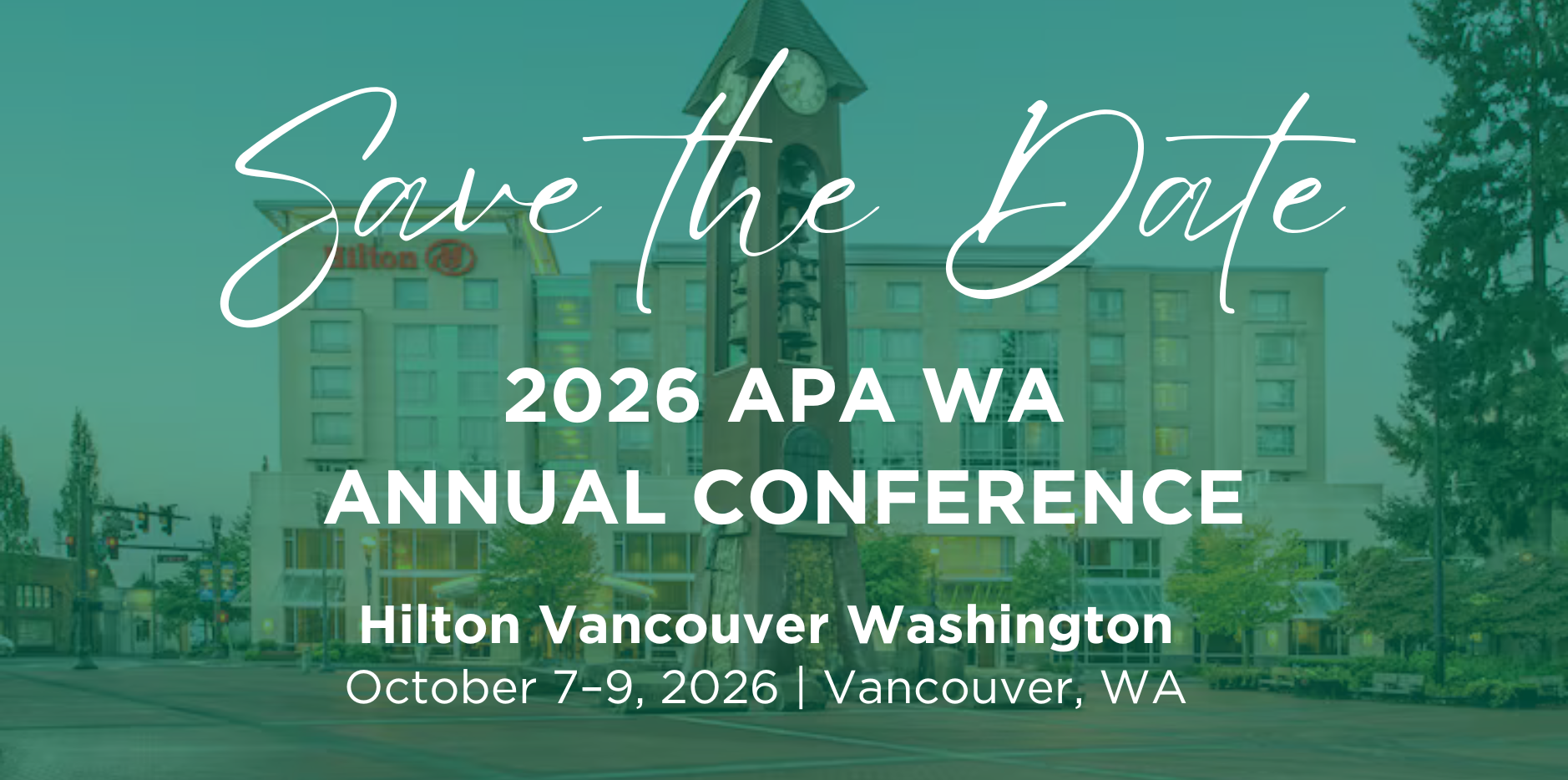
The Washington Chapter of the American Planning Association (APA WA) invites you to submit your session proposals for the 2026 Annual Conference, to be held October 7-9, 2026, at the Hilton Vancouver Washington in Vancouver, Washington.
Conference Theme
The 2026 conference theme is Level Up Washington: Planning for What's Next. This year’s conference is about stepping confidently into the future of planning – equipping planners and communities with the tools to adapt, innovate, and lead through change. It’s about leveling up our skills, partnerships, and approaches to deliver more equitable, resilient, and forward-thinking outcomes. Planners across the state are thinking boldly, acting strategically, and shaping what comes next. Come be part of it!
Conference Tracks
To support our conference theme, we are calling for session submittals and mobile workshops that align with one of the following tracks:
Track 1: Pulse on Policy and Law
The aim of this track is to deliver a timely look at the evolving legal and policy landscape shaping planning in Washington. This track can unpack recent legislation, case law, and how jurisdictions are responding. Sessions will focus on what’s changed, what's coming next, and how it affects your work on the ground. Designed to be both practical and forward-looking, this track equips planners with insights and tools needed to navigate complexity, reduce risk, and confidently turn policy and law into action.
What new laws, rules, or court decisions should planners be paying attention to right now?
What problems are policies and laws trying to solve—and are they working?
How will new requirements affect timelines, costs, and permitting processes? Are we achieving new state permit timelines?
What hasn’t worked—and what lessons have been learned?
How are agencies coordinating across departments (planning, legal, public works, etc.)?
What tools, partnerships, or funding sources can support implementation?
Are these policies advancing (or not advancing) equity and reducing disparities in real ways?
How is your jurisdiction using flexibility or local discretion to innovate?
What are planners hearing from developers, residents, and decision-makers?
Where are there disconnects between policy intent and real-world outcomes?
Planning isn’t static—it’s a living, responsive practice shaped by constantly shifting conditions, community needs, and real-time markets. Whether it’s Battery Energy Storage Systems (BESS), data centers, moratoriums, behavioral health facilities, or saunas by the sea, there is always something new to learn about! Rather than following a fixed playbook, planning requires adaptability, curiosity, and a willingness to rethink assumptions. The track aims to highlight the ideas, innovations, and voices shaping the future of planning in Washington and beyond. Sessions will explore new and cutting-edge topics, unconventional approaches, and lessons from adjacent fields that challenge traditional practices. This track encourages planners to think beyond silos, stay curious, and share their own on-the-ground experiences that are here today, and emerging tomorrow.
How are AI, data, and digital tools changing planning workflows and decisions?
What institutional barriers—technical, legal, or cultural—have you encountered, and how have you worked to address them?
What case studies from Washington State demonstrate meaningful improvements to planning outcomes?
How are privacy, data ownership, and public trust being addressed as technology use expands?
What signals (such as technology, demographics, economics) should planners be paying attention to now?
What perspectives are we missing when we stay within traditional planning approaches? How have you broadened your awareness?
What long-standing planning assumptions or practices no longer serve us?
What unconventional strategies or pilot projects are showing promising results?
What felt “cutting edge” when you worked on it, but you anticipate will become a mainstream issue in the next few years?
What are you testing in real-world conditions?
Data and data analysis
Land uses that are new or unconventional
Code enforcement, vacant properties, and unpermitted uses
Transportation innovation
Community engagement (e.g., multilingual engagement, real-time translation)
Scenario, growth management, and land-use modeling
Environmental justice
Legal and ethical considerations Colleges, universities, and local schools as technical partners
Tremendous effort goes into creating comprehensive plans – no matter the size of the jurisdiction. The end result entails maps detailing the conditions of the built and natural environment, and a plethora of policies to guide development. The next step is implementing those policies through development regulations, sub-area plans, community programming, and public engagement. Another step involves tracking the progress of implementing the comprehensive plan. This track is an opportunity to share achievements and obstacles in making comprehensive plan goals a reality.
What strategies are there for evaluating implementation progress?
What does evaluating implementation progress imply?
How can software/programs assist in updating maps depicting the built and natural environments?
How to coordinate with other local departments/divisions to implement the comprehensive plan?
How to achieve goals and policies with a changing legislative landscape?
How to establish a comprehensive plan that provides flexibility for incorporating dynamics of tribal sovereignty?
How to achieve concurrency and consistency with neighboring jurisdictions and in areas outside of your jurisdiction?
How to align existing sub-area plans with new comprehensive plans? When/How/Why/Did you phase out plans that no longer align with your recently adopted Comprehensive Plan?
What resources have you found to overcome fiscal constraints that prevent implementation?
How do you prioritize implementing projects and policies and address potentially conflicting goals?
Comprehensive plan implementation across multiple departments
Strategies to achieve the realization of re-development plans (economic, green, communal)
Implementing policies in conjunction with countywide and multi-countywide policies
Communication of the comprehensive plan policies and goals to other staff
Scenario planning case studies
Code updates and preemption – what to know?
SEPA
Comprehensive plan map amendments – the basics/docketing how-to
Implementing plans a new administration is against
The planning profession is evolving rapidly – new tools and technologies, shifting regulations, changing community expectations, and complex challenges require planners to continuously expand their skillsets. This track focuses on practical, hands-on learning that helps planners at all career stages level up their capabilities. From mastering new software and data analysis techniques to sharpening facilitation and communication skills, these sessions provide actionable strategies and frameworks you can immediately apply in your work. Whether navigating GMA updates, building climate literacy, improving equity practices, or strengthening your technical toolkit, this track equips you with the skills to plan for what comes next.
What strategies help planners effectively facilitate difficult conversations and navigate conflict in community engagement?
How do we develop skills in implementation and project management to move plans from paper to reality?
What professional development pathways and resources are available to planners in Washington State?
How can planners build cross-sector collaboration skills to work effectively within agencies as well as with housing developers, transportation agencies, tribal governments, and community organizations?
What technical skills and tools do planners need to effectively analyze and communicate complex data?
How can planners build capacity in climate adaptation, environmental justice, and equity-informed practice?
Facilitation skills for contentious public meetings
Building relationships with tribal governments and practicing government-to-government consultation
Data visualization and storytelling with numbers
Conflict resolution and mediation techniques
Project management fundamentals
Reading and applying housing market data
GIS and spatial analysis for non-experts
Climate literacy for planners: understanding science, impacts, and solutions
Planning ethics
Planning law essentials for non-attorneys
Translating complex technical documents for public consumption
Communities across Washington increasingly face the challenge of balancing development needs while protecting natural systems that sustain us. This track explores how planners can meaningfully collaborate with communities, particularly those historically underrepresented, while protecting ecosystem functions and planning for the impact of climate change. Sessions in this track will highlight practical tools, cross‑disciplinary partnerships, and community engagement strategies that consider the deep connections between people and nature.
How do we elevate community voices, especially those most impacted by environmental risks?
What strategies are communities using to restore habitats, protect critical areas, and build resilience to the impacts of climate change and natural disasters?
What kinds of creative programs or codes help us promote tree retention while providing housing?
What green building and low impact development strategies, regulations, and incentives has your community implemented?
In what ways can planners strengthen relationships with tribes to support land stewardship, tribal ecological knowledge (TEK) and shared decision‑making?
How can we get community buy-in on environmental policymaking in resistant communities?
What are strategies to assess and communicate costs and benefits for long-term and future issues?
What are tips for coordinating with emergency management, public health, capital projects, and other disciplines.
Nature‑based development solutions for climate resilience
Green infrastructure and low‑impact development strategies
Community outreach strategies exploring climate resilience and development needs
Tribal co‑management and shared stewardship frameworks
Environmental justice in local planning
Urban forestry and planning department collaborations
Wildfire, climate change, and protecting housing
Parks, open space, and trail planning
Floodplain and shoreline adaptation approaches
Farmland and working lands preservation
Partnerships with conservation districts, land trusts, and environmental organizations
Comprehensive plans, climate elements
Critical Areas Ordinances and Shoreline Master Programs
Breakout sessions are 75-minute, topic-focused sessions held onsite in standard conference rooms equipped with A/V. These sessions take place concurrently as part of the larger conference program, allowing attendees to choose topics most relevant to their interests. Common session formats include traditional presentations, panel discussions, and interactive small-group activities. Proposers are encouraged to design sessions that promote participation, dialogue, and practical takeaways, creating a more dynamic and collaborative learning experience.
Mobile Workshops are sessions that take the learning outside the session room. These 90-minute sessions (or 2.5 hours, if appropriate) showcase local projects to conference attendees. A few past examples include a tour of an art district, exploring transit-oriented developments and trail connections, and experiencing urban nature at a city park.
These offsite locations should be accessible by walking or by other transportation. If a rented bus is necessary, the conference will charge a fee to cover the transportation costs. Session proposers are encouraged to seek inexpensive or free transportation arrangements (e.g. using municipal or otherwise donated buses), or the conference staff will identify a local vendor and that cost will be incorporated into the session fee.
This fast-paced, fun session gives speakers the opportunity to showcase their planning prowess. Presenters are encouraged to share something that is thought-provoking and novel (and possibly light-hearted and entertaining!). Presenters will prepare a 20-slide deck where each slide is displayed for only 20 seconds, and the whole presentation is no longer than 6 minutes and 40 seconds. To meet the time requirements, practicing ahead of time is key!
Topic and Presenters:First, decide on your topic and think through the story to be told and who would tell that story the best. You are welcome to invite non-planners to present if their comments add to the topic, as well as academics whose research may further support the approach you are discussing.
The following information is required during the Session Proposal submission process:
Session Title - 15-word limit
Full Session Description, including the objectives of the session - 600-word limit
Short Summary of Session for Conference Marketing - 150-word limit
Session Coordinator Contact Information - session selection emails will be sent to the coordinator after the Program Committee reviews submissions
Speakers - names, certifications, titles, organizations, email address, and biographies
Moderator (if appropriate for panel) - name, certification, title, organization, email address, and biography
Audio visual requirements
Please provide as complete a proposal as possible. Complete proposals make it easier for us to complete CM application forms and score proposals received. The selection committee will score complete proposals higher than incomplete proposals! If your proposal is selected, any missing information needed for CM forms will be due by July 13, 2026.
Selection Criteria
Complete the submission form by May 14, 2026. The Program Committee will select conference sessions considering the following criteria:
Proposal provides the information requested above.
Session is unique, engaging, and correlates with the conference theme and its tracks, and represents the breadth of issues that planners throughout the state encounter.
Session includes APA/AICP members, although panels that offer a diversity of perspectives (e.g. other professions, non-APA members, and geographic diversity) are also encouraged.
The Program Committee will select sessions that represent a breadth of topics, geographies, firms, agencies, and individual presenters. Please keep this in mind as you propose sessions. Also, the Committee is responsible for overseeing the content of each session and, as the conference program develops, edits to proposals, suggestions for additions, or other changes may be requested to better balance each session.
Conference Sessions will offer AICP Certification Maintenance credits wherever possible, so session organizers are asked to review CM learning criteria below and structure their proposals to meet these criteria.
CM Criteria: Your session description must describe how your session meets the following criteria:
Does the presentation offer a professionally relevant learning experience for a planner (i.e. for a planner with at least four years of experience after earning a two-year master's degree)?
Does the training content address the educational needs of AICP members, as outlined in AICP’s Core Competencies?
What are the specific planning-related training objectives and how does this session meet them?
Have you documented in the speaker biography that the speaker has some expertise in the topic (i.e. is a “subject matter expert”)?
There are four mandatory categories of CMs — Ethics, Law, Equity, and Sustainability and Resilience — that AICP planners must acquire during each two-year reporting period. To propose a session offering one of the mandatory credits, at least one speaker must be AICP certified; additionally, law credits require that a majority of speakers be AICP certified. In addition, your Session Description must include an explanation of how your session meets the Mandatory Session Criteria (see Criteria for CM Mandatory Credits (planning.org).)
Please reference CM learning criteria while completing your session proposal form so the Washington chapter can ensure sessions are CM-eligible.
We do not pay honoraria or reimburse for travel or lodging expenses. Speakers are required to register for the conference. If the speaker is attending only the session at which they are speaking, then registration may be waived. Speakers whose fee is waived in this manner may not participate in any other sessions, ticketed events, or meals.
Members of sessions selected will be notified once conference registration is live.